Impact




Impact
UMI strives to address social challenges and realize a sustainable future by leveraging materials and chemical technologies developed in Japan. We integrate environmental, social and governance (ESG) considerations into our investment activities, pursuing a balance between economic and social values.
UMI is a signatory to the Principles for Responsible Investment (PRI), and we conduct our investments in accordance with those principles. We place strong emphasis on active engagement with our portfolio companies, and are committed to being a partner that supports sustainable growth. Sustainability forms the core of our purpose and growth strategy.
UMI conducts investment activities incorporating ESG issues and became a PRI signatory in June 2021.

Diversity, Equity and Inclusion Policy ›
As a member of the Japan Venture Capital Association (JVCA), we have formulated a Diversity, Equity and Inclusion Policy.
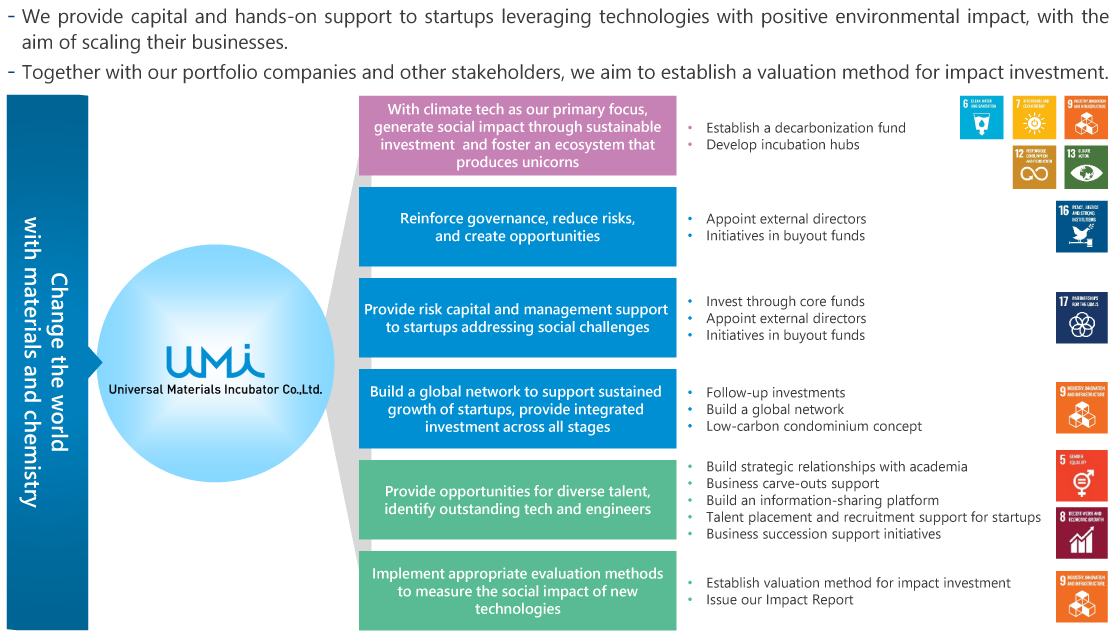
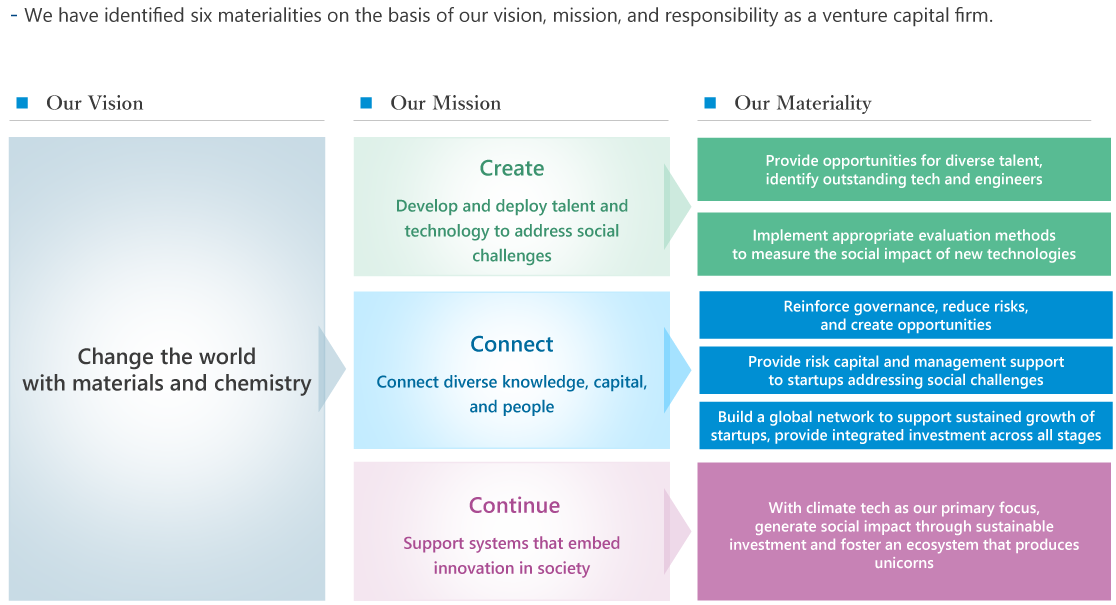
In order to leverage UMI’s expertise in the materials and chemical fields to realize sustainable growth, we have organized our core challenges and identified six materialities. These form the central themes supporting our business operations and investment decisions: Technology and Talent Development, Appropriate Impact Assessment, Strengthening Governance, Startup Support, International Collaboration, and Creating Value in Climate Tech.
Guided by these materialities, UMI will coordinate with our portfolio companies and stakeholders to pursue a continuous balance between creating social and environmental value and generating economic returns.
At UMI, the Representative Director bears ultimate responsibility for sustainability, and ESG initiatives are promoted under the leadership of the responsible officers. We consider ESG perspectives in our investment decisions and monitoring, and incorporate external expertise as necessary. In addition, we provide training to deepen fundamental understanding of ESG among officers and employees, and we promote sustainability-conscious management throughout the organization.
UMI has a clear policy for considering ESG elements in our investment process. Before investing, we identify ESG risks and opportunities, and after investing, we support improvements and value enhancements through ongoing engagement with our portfolio companies.
Furthermore, we practice responsible investment in line with the PRI, and provide appropriate information to investors and stakeholders. We maintain our stance of prioritizing sustainable growth over short-term profits. UMI promotes impact investment in innovative technologies in the materials and chemical fields, aiming for a balance between addressing social challenges and generating economic returns. We evaluate the performance of our portfolio companies from both quantitative and qualitative perspectives as far as possible, and disclose the results transparently.
By nurturing technologies that society needs and supporting their commercialization, we contribute to realizing a sustainable future.
UMI conducts periodic Climate-Related Business Opportunities assessments to evaluate the extent to which the products, services, technologies, and business activities of its portfolio companies contribute to the creation and expansion of Climate-Related Business Opportunities. Through these assessments, UMI continuously monitors portfolio companies’ responses to climate change, as well as the development of business opportunities that support the transition to a decarbonized society.
At UMI, we aim to realize a sustainable future through investment in technologies and businesses that contribute to solving environmental and social challenges. For this purpose, we have introduced our proprietary “Unit Impact Calculation Methodology” to quantitatively assess the impact of our portfolio companies.
Our “Unit Impact Calculation Methodology” was developed with reference to the following document issued by Japan’s Ministry of the Environment.
Source: Ministry of the Environment, For Investors and Startups: Guide to Climate Tech Greenhouse Gas Impact Calculation and Assessment (November 2024).
https://www.env.go.jp/content/000265710.pdf
This document outlines the construction of a logic model based on Life Cycle Assessment (LCA) and an approach to impact assessment through comparison with a baseline. Based on this guidance, UMI has developed our own evaluation methodology.
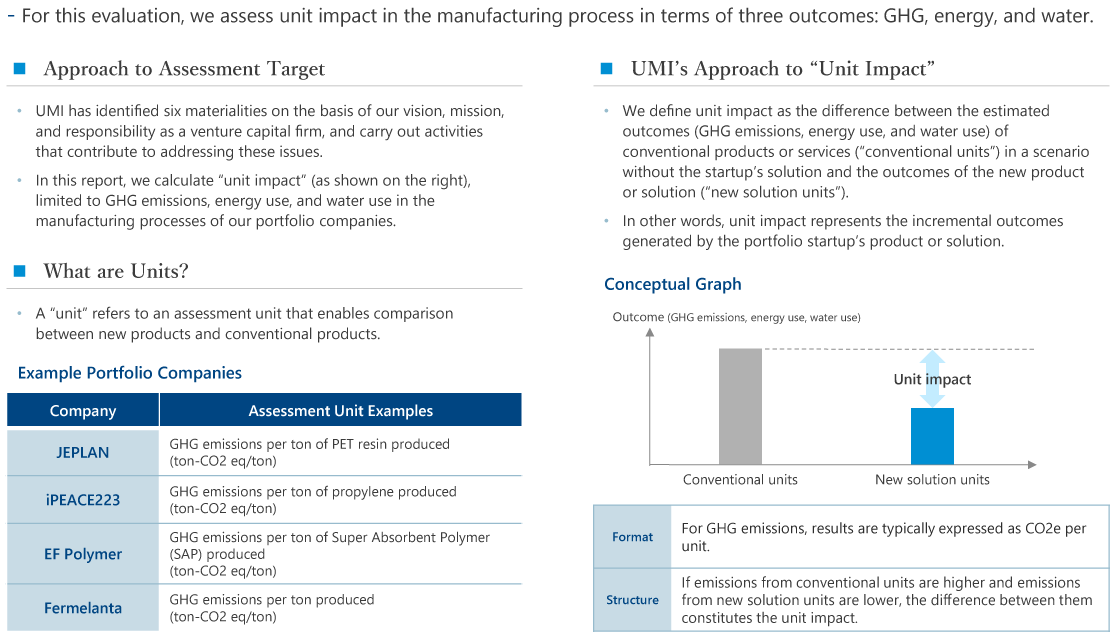
Unit impact is a quantitative indicator applying to each assessment unit, measuring the difference in environmental impact (greenhouse gas emissions, energy use, and water use) between conventional technologies and novel solutions. Using this method, UMI objectively assesses the environmental and social value of our portfolio companies, and makes investment decisions with a high degree of transparency.
Unit impact is calculated using the following steps:
Clarify the results (greenhouse gas reduction, water use reduction, etc.) generated by the solution targeted for investment. At this stage, build a logic model based on Life Cycle Assessment (LCA) and organize the cause-and-effect relationship from input and activity to output and results. This enables us to explain quantitatively and persuasively the mechanism by which impact is generated.
Define the scope of assessment to cover the entire life cycle, from raw material procurement to disposal.
Establish comparable units (e.g., per ton, per 1MWh) for the product or service being assessed.
Refer to reliable emissions coefficients and assessment indicators based on the Ministry of the Environment’sFor Investors and Startups: Guide to Climate Tech Greenhouse Gas Impact Calculation and Assessment (November 2024).
Clarify the reduction effects through comparison with conventional technologies.
Collaborative engagement that we have expressed endorsement for through the PRI
STATEMENT FROM THE PRIVATE FINANCIAL SECTOR TO THE MEMBER STATES NEGOTIATING THE INTERNATIONAL LEGALLY BINDING INSTRUMENT (ILBI) TO END PLASTIC POLLUTION
Statement and list of signatories ›
Spring is a PRI stewardship initiative for nature, convening investors to use their influence to halt and reverse global biodiversity loss by 2030